EFFAS Webinar Highlights
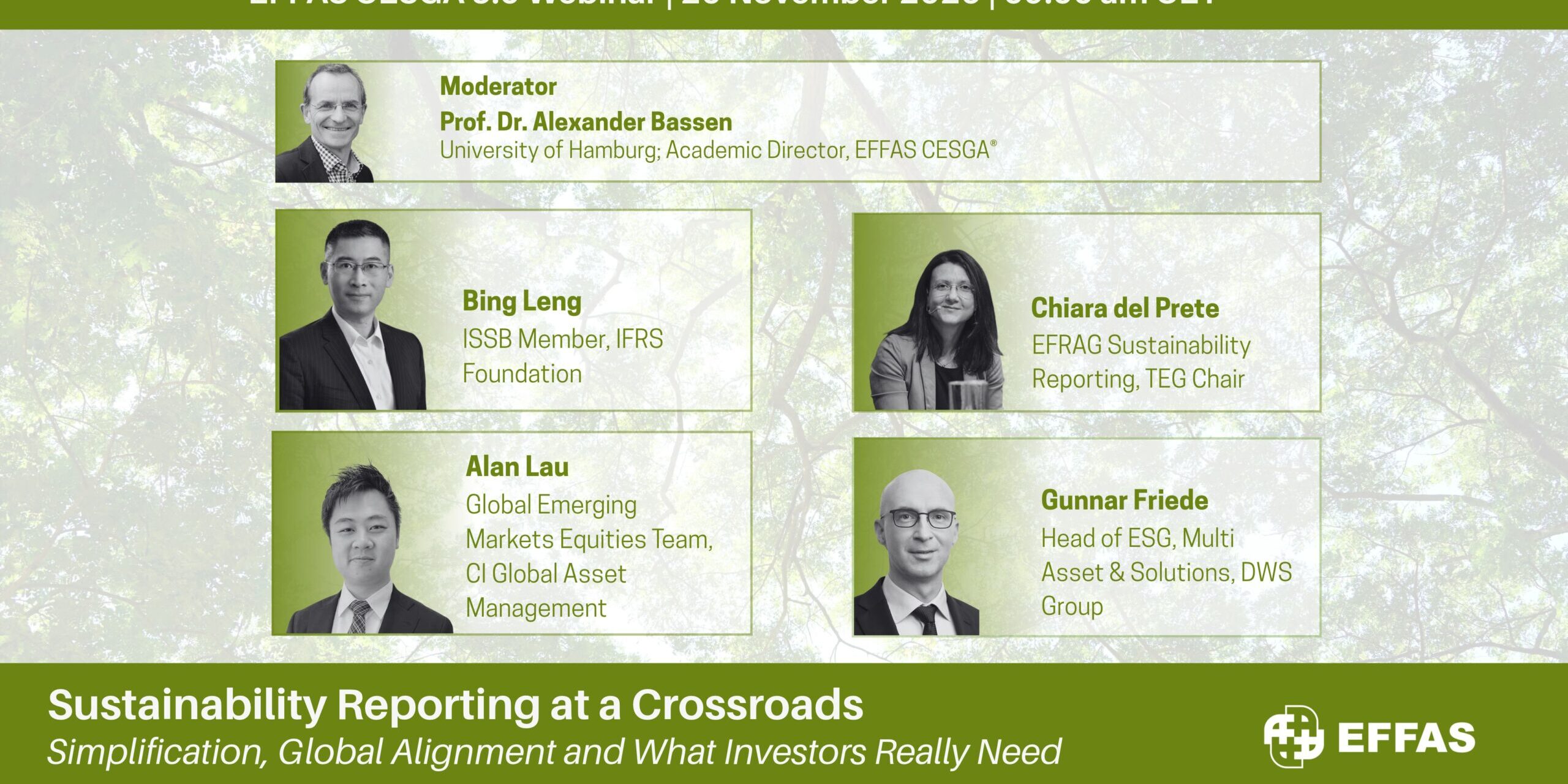
Sustainability Reporting at a Crossroads
23 November 2026 | Frankfurt am Main
Sustainability reporting is evolving rapidly, but what information do investors actually need?
This was the central question of EFFAS’s webinar, moderated by Prof. Dr Alexander Bassen, Academic Director of CESGA®, bringing together two leading sustainability standard-setters and two experienced investment professionals:
- Chiara Del Prete, Chair of EFRAG’s Sustainability Reporting Technical Expert Group
- Dr Bing Leng, Member of the International Sustainability Standards Board (ISSB)
- Dr Gunnar Friede, Head of Investment Strategy and ESG Multi Asset, DWS
- Alan Lau, Global Emerging Markets Equities Team, CI Global Asset Management
The discussion explored the EU Omnibus initiative, simplified ESRS, international interoperability and the practical application of sustainability information in investment analysis.
Five key takeaways
- Simplification should improve the usability of sustainability data, not undermine transparency.
Chiara Del Prete explained that the simplified ESRS aim to significantly reduce reporting complexity while preserving the standards’ underlying transparency objectives. The reduction is particularly substantial for narrative requirements, while core quantitative disclosures have been more extensively retained. She also acknowledged certain information losses and potential trade-offs in comparability.
Gunnar Friede welcomed a greater focus on reliable, relevant and forecastable information, while highlighting the continuing need for closer alignment between corporate disclosures and investors’ own reporting requirements.
- Interoperability is progressing, but practical differences still matter.
Bing Leng emphasised the considerable alignment already achieved between the ISSB Standards and ESRS, particularly on climate, while identifying remaining differences concerning financed emissions, disclosure reliefs, transition plans and anticipated financial effects.
Chiara stressed that the overlap between the frameworks needs to be communicated more effectively. The discussion also explored ISSB-based reporting with jurisdiction-specific additions and the potential for reporting approaches that reduce unnecessary duplication.
- ESG information becomes valuable when it affects financial analysis.
The buy-side panellists demonstrated that sustainability information is used not only for disclosure compliance but also for forecasting, risk assessment, portfolio construction and corporate engagement.
Alan Lau highlighted the implications of energy and water requirements for AI data centres. Such factors can influence project permissions, development timelines, asset values and ultimately investment decisions.
Gunnar Friede underlined the importance of consistent, comparable ESG data over time, enabling investors to assess risks, develop forecasts and compare companies across portfolios.
- Transition plans stood out as particularly decision-useful.
In the audience poll, transition plans were the most frequently selected disclosure among those reported to have influenced a valuation, forecast or portfolio position during the previous 12 months.
The discussion highlighted why transition plans matter: they connect quantitative indicators with a company’s strategy, implementation plans, operational resilience and future financial performance.
- Impact information can provide early signals of financial risk.
The panellists explored how environmental and social impacts can become financially material over time.
Examples included water scarcity, energy constraints, extreme weather, permitting risks and operational efficiency. Such information can provide valuable early warning signals before the financial implications are fully reflected in company accounts.
What did the audience tell us?
Finding | Poll result |
Greater interoperability or reduced complexity between ESRS and ISSB is desirable | 96% (46/48) |
Simplification will leave ESRS use unchanged or increase it | 86% (36/42) |
ESRS was selected as the most decision-useful reporting framework among the listed options | 45% (20/44) |
Transition plans were the most frequently selected disclosure influencing a recent financial decision | 48% (15/31) |
Join the next CESGA 5.0 Free Webinar
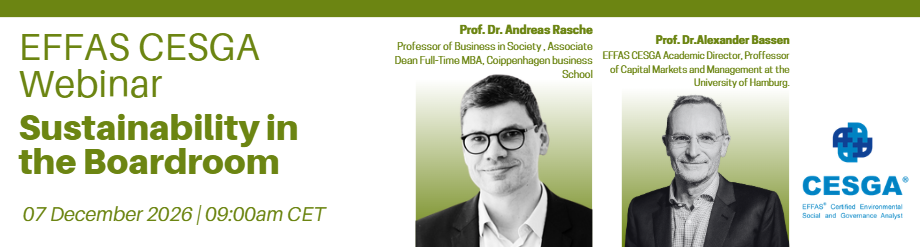
Sustainability in the Boardrom.
As companies navigate evolving sustainability regulations, investor expectations and economic pressures, corporate boards face important questions about their responsibilities, priorities and oversight of sustainability-related risks and opportunities.
Join EFFAS for a discussion with Prof. Dr. Andreas Rasche, Professor at Copenhagen Business School, and Prof. Dr. Alexander Bassen, CESGA Academic Director and Professor of Capital Markets and Management at the University of Hamburg.
Drawing on their expertise in corporate governance, sustainability and financial markets, the speakers will explore how sustainability considerations are addressed at board level and what effective
About EFFAS
EFFAS, the European Federation of Financial Analysts Societies, is the home of Europe’s financial community. Founded in 1962 as a not-for-profit umbrella organisation, it brings together 15 National Member Societies representing more than 18,000 investment professionals, including financial analysts, portfolio and asset managers, pension fund managers, corporate finance specialists, risk managers and treasurers. EFFAS sets professional standards, represents the user side in Europe’s key regulatory and standard-setting bodies, and has more than 29,000 certificate holders worldwide. www.effas.com
For any further information, please contact:
Álvaro Wagener Díez | Marketing & Communications Manager
E-mail: a.wagener@effas.com | Phone Number: +49 69 98959519